Available 2026Computational SociologistAI/ML BuilderMethods Pragmatist
PatrickBurnett
Tools for thinking with data.
By training, a relational sociologist. By trade, a methodologist who builds — scoping the question, running the analysis, shipping the system you actually use. Currently taking on contract work in applied AI, mixed-methods research, and data infrastructure for mission-aligned teams who need someone who can do both the science and the build.
What I doMixed-methods research · Survey design & analysis · Machine learning & NLP pipelines · Interactive data visualisation & mapping · Field analysis & relational data work
Where I have depthSex industry safety · Health practices & harm reduction · Higher education & academia · Marginalised populations the market doesn't serve well
By training, a relational sociologist. By trade, a methodologist who builds — scoping the question, running the analysis, shipping the system you actually use. Currently taking on contract work in applied AI, mixed-methods research, and data infrastructure for mission-aligned teams who need someone who can do both the science and the build.
Visualizations, apps, dashboards, internal tools. Where complex problems meet design, method, and a refusal of flat answers. Every project a design question, every output a resolution.
2017 + 2019 · MCA Models
Field-of-power, in three & four dimensions
First explorable 3D MCA — and, to my knowledge, the first 4D. Open three.js framework in development.
02 / Subfield
A registry of Canadian academia, made queryable.
Mapping the academic labour market — every full-time faculty member, where they trained × where they teach. The institutional census Patrick and @FrancoisLachapelle built together because nobody else was.
~/sociologix/subfieldhistory --collection
How it started — 4,934 records, hand-pulled from UBC basement microfiche with @FrancoisLachapelle for the 2018 Canadian Review of Sociology paper.
[METHOD] page-by-page, hand-collected together from academic calendars + microfiche
[PAPER] Lachapelle & Burnett · Canadian Review of Sociology · 2018
Months in the UBC basement archives, page by page. We built something special together — the work won the CSA award, laid the trust layer that runs through Subfield today, and from here, we're going big.
~/sociologix/subfieldpipeline --status
How it scales now — a nightly automated census across all Canadian academia, with the same trust layer the original two-person collection earned.
[CENSUS]85,000Canadian academics · 102,000 records · 2026 refresh in collection
[INST]87 universities, all ROR-mapped · 144 raw ranks → 7 master levels
[INTL]2026–2027 US census in active design + testing · collection soon
Census-level, not aggregate. Self-collected, owned outright — no third-party data partner whose pricing changes the product overnight. Every cleaned field has a _raw sibling so you can trace any number back to where it came from.
~/sociologix/subfieldsurfaces --list
What you'll be able to do with it — Atlas for curated findings, Explore for filter-driven investigation, both shipping Q4 2026.
[EXPLORE] filter university × field × CIP × rank × year × gender, linked views, shareable URLs
[RANK] placement strength · hiring breadth · training centrality
[+]more dimensions in collection — you'll have to wait to see them
Existing rankings are reputation polls or citation counts. Subfield asks the question grad students actually need answered: where do this program's PhDs end up?
~/sociologix/subfieldask --preview
Ask the data in plain English — a conversational layer over the full Subfield corpus, designed in the same vein as patrick.exe but pointed at the dataset itself. In design now, validating with a small group of users post-Atlas.
[CONTEXT] field-aware — knows the difference between PhD origin and current employer, between rank and tier
[GROUND] answers cite the rows behind them — same _raw provenance, surfaced inline
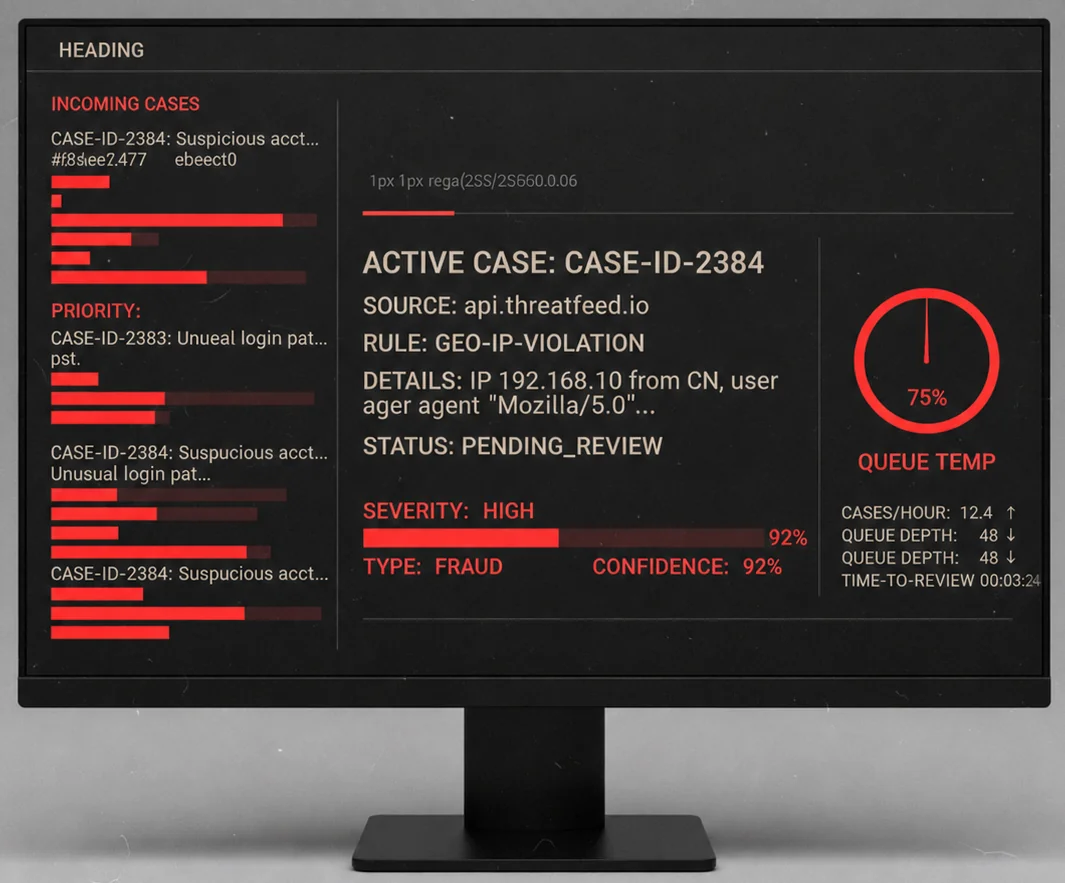
Building a custom NLP lexicon for an industry whose language mainstream AI refuses to read — slurs, code-words, services, acts, the language of violence. Models trained locally, run locally; no third-party APIs between us and the work. Four interlocking workstreams: triage, mapping, collection, publication.
Mainstream language models reject this domain's vocabulary — slurs, code-words, violence-language. Built a custom lexicon and trained classification models locally to score severity and type. ML and NLP for sensitive populations where general-purpose systems fall short.
Machine Learning · NLP · Custom Lexicon
ongoing
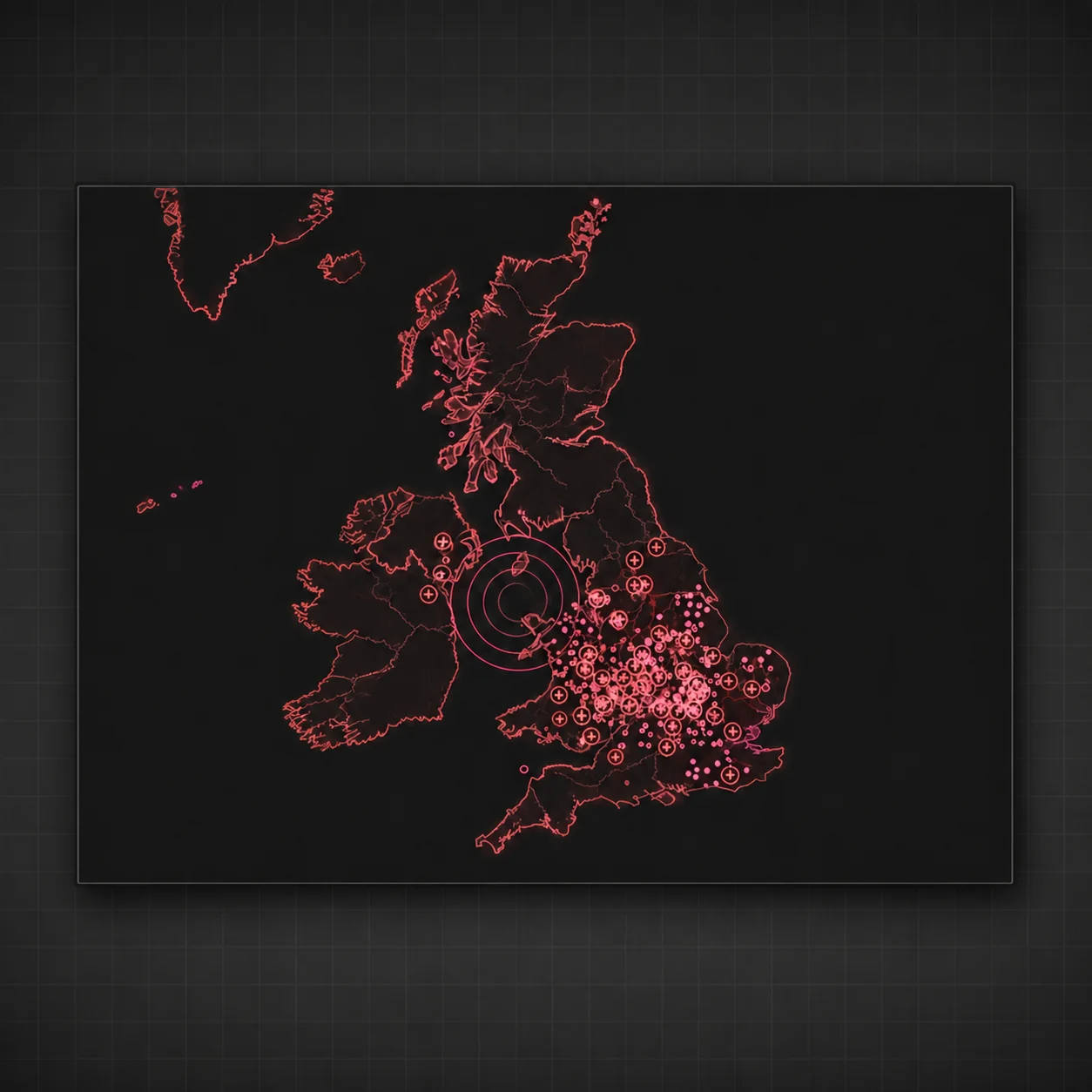
Geographic map: cases pinned with memorial overlays
The Memorial Map
The geographic record of every case the project has tracked, paired with the memorials that hold those names. We're rebuilding the schema for continuous collection, dignity-first storage, and expanding coverage to additional regions.
PostgreSQL · Geospatial · Schema design
dev + testing
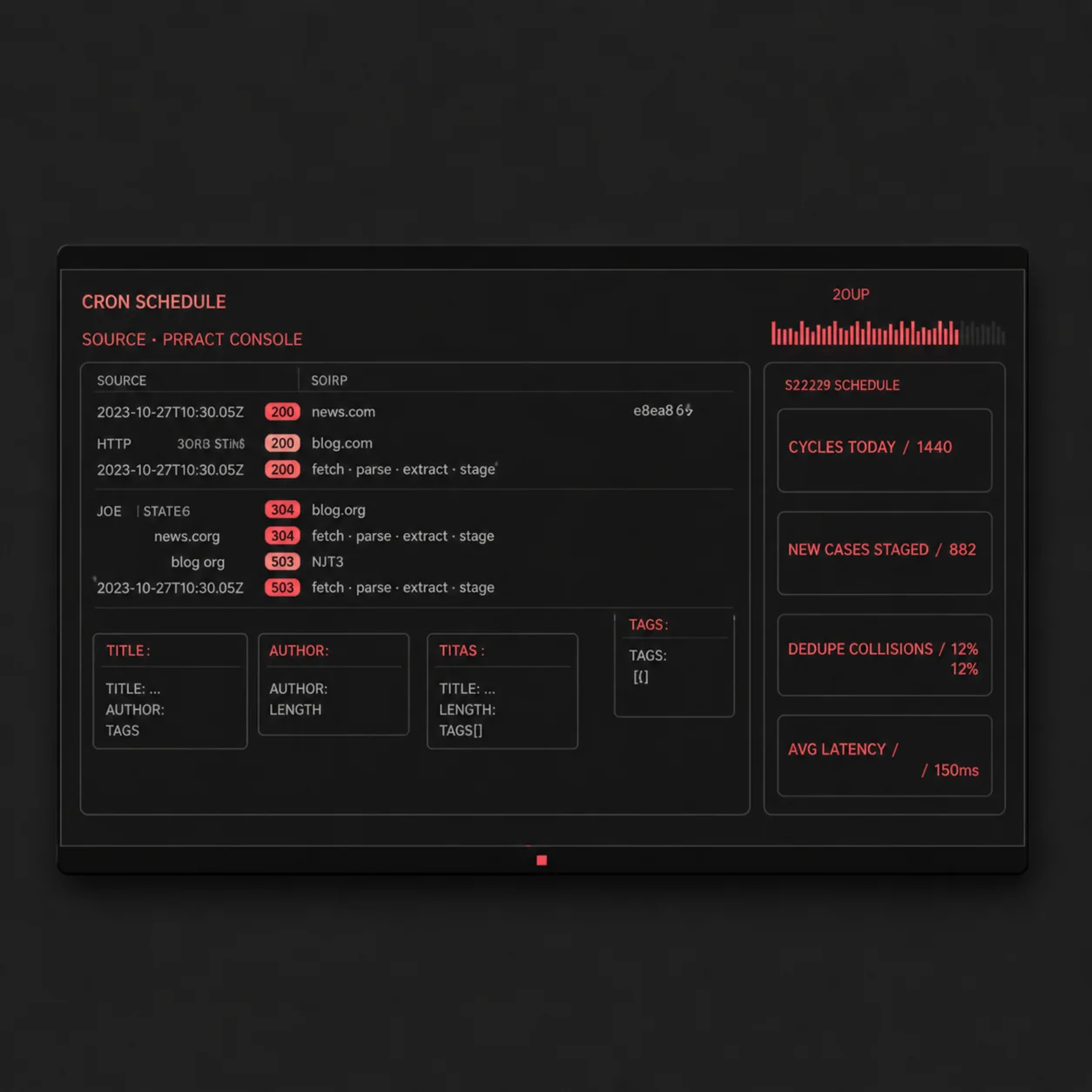
Crawler console: job feed + extraction status
News Crawler
Build-out of the Memorial Map... automating data collection on violence against sex workers. Press coverage sits buried in vice columns and regional papers; the crawler reads the cycle and stages new incidents. Originally a postdoc, now self-funded.
Python · Scrapers · ETL · Funder-seeking
dev + testing
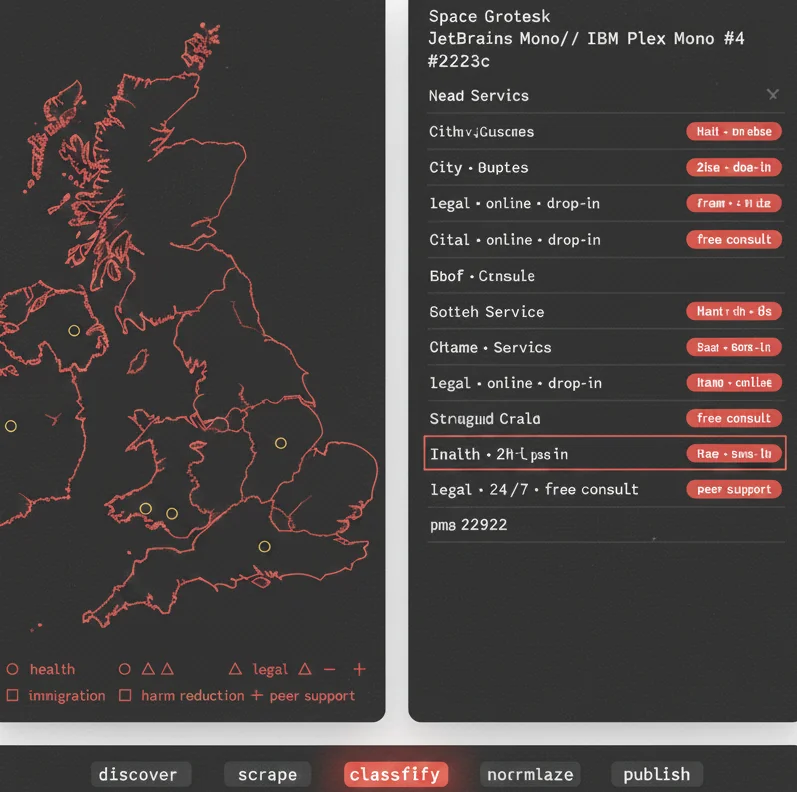
Resource map: scraped, validated, navigable
Resource Pipeline
A scraper-and-validation pipeline. Pulls candidate resources from across the web, runs each through a validation pass — dead-link checks, scope matching, source quality — and surfaces only legitimate entries into a navigable map for the population it's built for.
A family of NLP-enriched networks for public research use.
Each one a different field — same conviction that knowledge gets better when you can see the shape of it. Following the paths surfaces what a keyword search can't: bridging authors, adjacent literatures, the researchers between clusters whose work you'd miss reading only inside your own. Free, public, navigable. Open to building new networks for sub-fields whose communities need one.
47,789 papers · 62,190 authors · 175,918 connections. Co-authorship and topic clusters auto-labelled with NLP; populations and study geographies extracted from titles and abstracts.
Cross-disciplinary view: fields fused into one terrain
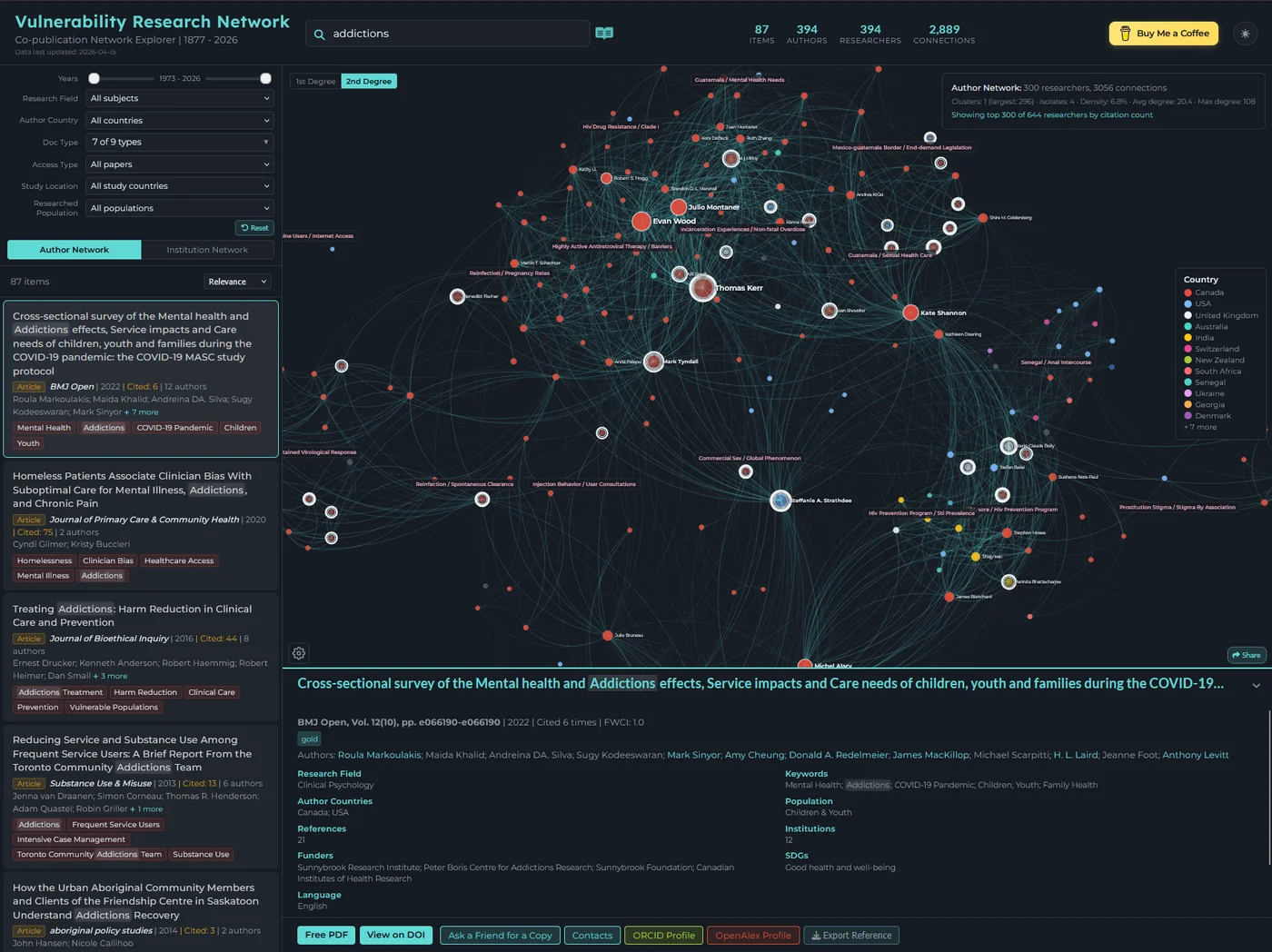
Vulnerable Populations
Research on vulnerability sits in journals that rarely cite each other — public health, criminology, social work, disability studies. A network that pulls them into one navigable terrain, with NLP-tagged populations and study contexts.
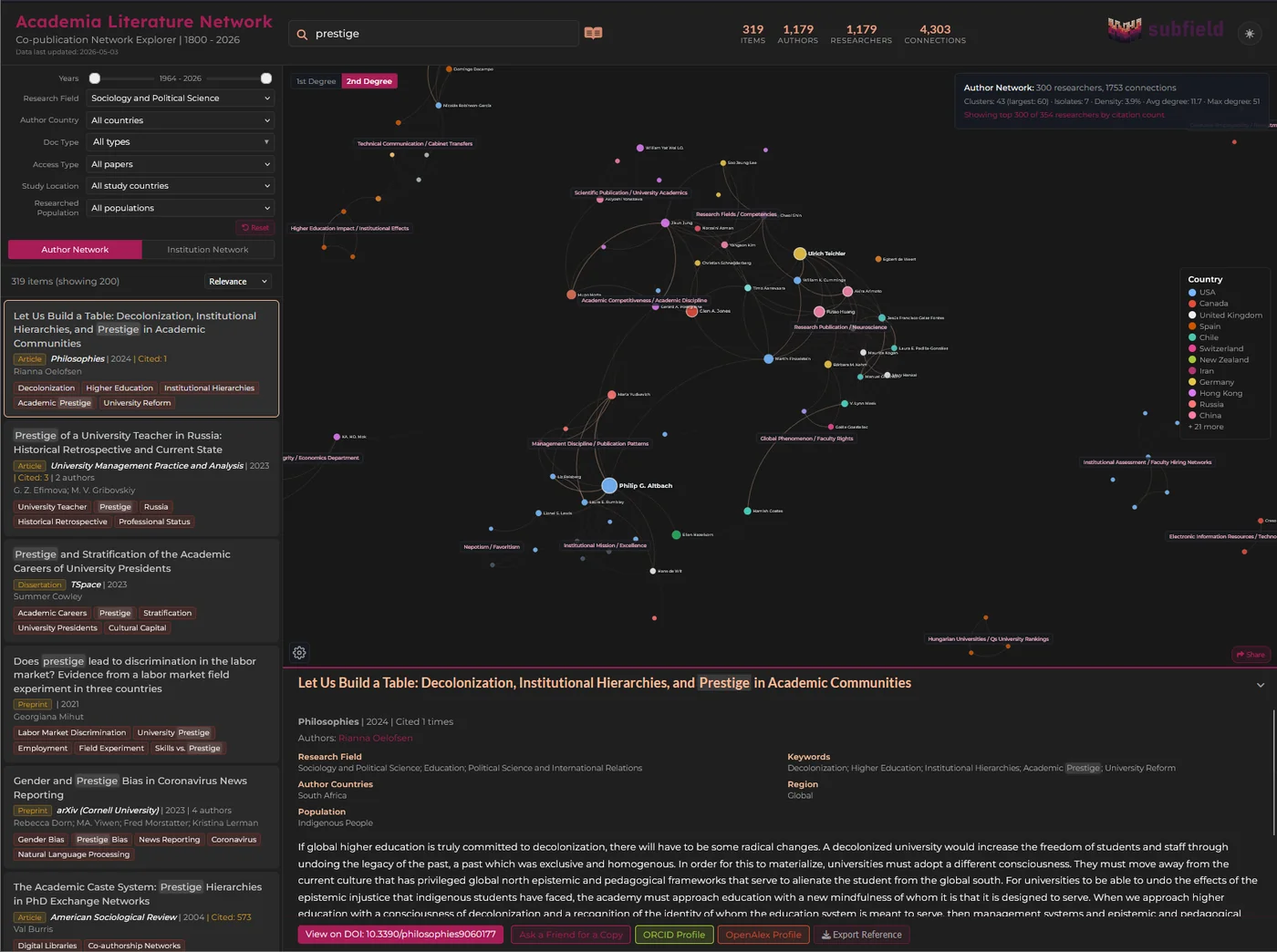
A meta-network mapping the academic research enterprise across disciplines and decades. Which fields cluster, which authors bridge, where the structural gaps are — at a corpus scale orders of magnitude larger than any single field.
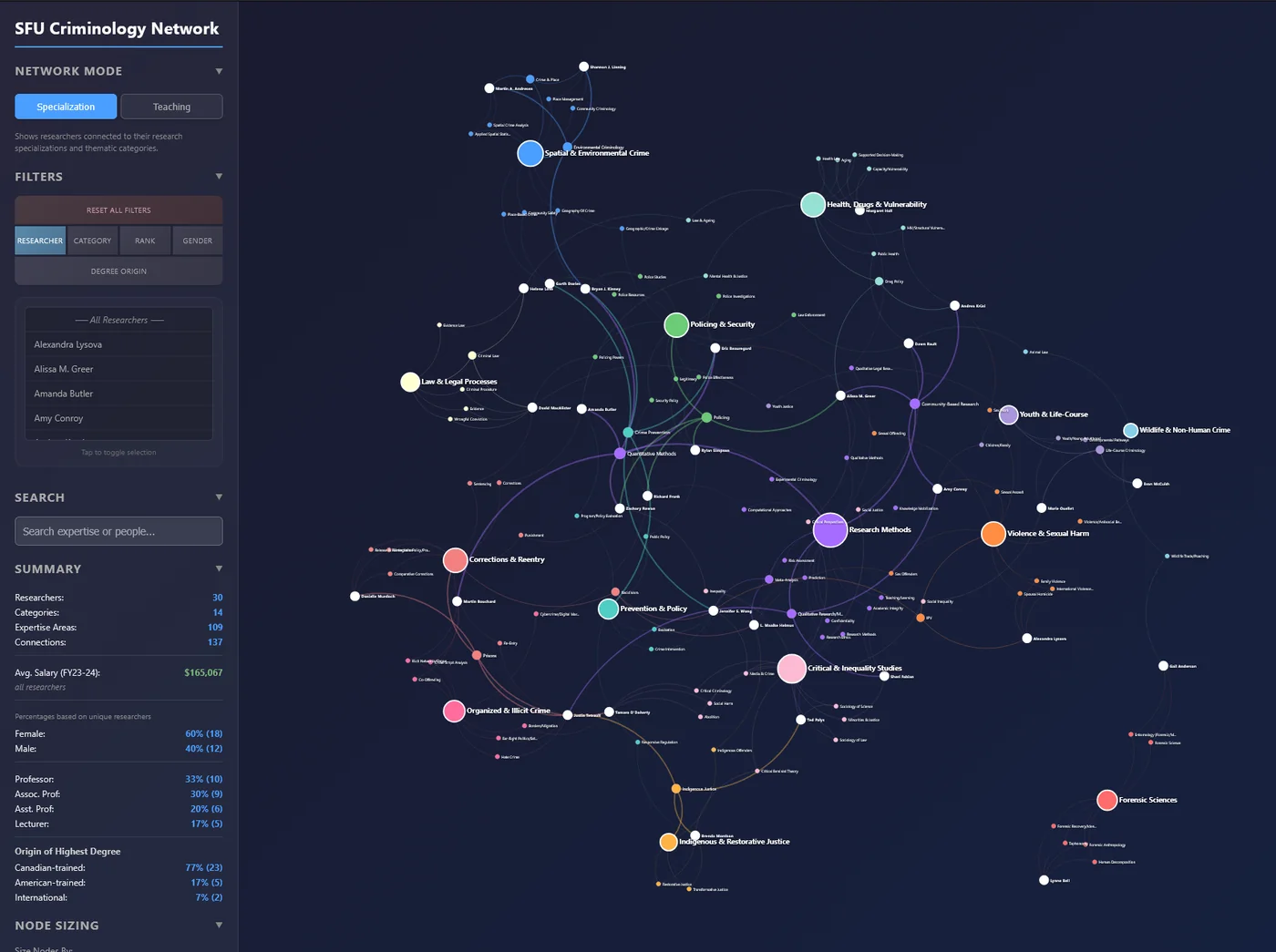
Department audit tool: faculty specializations, teaching, summary stats
Criminology Department · Audit Pilot
A department-level audit tool, not a co-publication network. Maps faculty by research specialization and teaching coverage. Live summary stats: gender, salary by rank, training origin. Pilot data anonymized; aggregate patterns preserved.
~/sociologix/networksrequest --new-field<your-field>→ ask patrick.exe how
05 / Publications
Theory, method, and research in action.
A decade of arguments and applied work — peer-reviewed papers, dissertation chapters, working drafts — kept here as files because that's still how the work moves. Hover one for a one-line read; click to open. Published papers route to the publisher; drafts open in-terminal with a download for the original. For the connective tissue between any two of them, ask patrick.exe — that's literally why he's here.
Working draft · Comprehensive examination · UBC Sociology
The Dynamics of Time and Space in Sociological Theory
Patrick Burnett · 2013 (revised draft 2018)
Argument in one paragraph
Sociology's perennial debates — structure vs. agency, individual vs. society, quantitative vs. qualitative — collapse into a deeper, more useful frame: time and space. Reading Durkheim, Marx, Weber, Bourdieu, Foucault, Tilly, Bergson, Schutz, Mead, Tarde, Elias, Simmel, and Mische through the dimensions of how each handles past/present/future and homogeneous/heterogeneous space, the apparent oppositions between thinkers reveal substantive overlaps and a shared concern with anticipating the social future.
Five sections
Linear-causal time and homogeneous space — Durkheim's universalist social facts.
Non-linear time and homogeneous space — Marx, false consciousness, the productive forces.
Non-linear time and heterogeneous space — Foucault's heterotopias, Bourdieu's fields, Einstein's relativity as analogy.
The inner dynamics of social spaces — habitus, doxa, the past-in-present, the anticipation of probable futures.
Inter-spatial movement — Simmel's stranger, Mead, Tilly. How carriers of experience change fields.
Key moves
Sociology overwhelmingly handles past + present; the future is the gap. Most theory infers the future inductively from past observation, which loads in deterministic assumptions.
The structure/agency debate is mostly a timescale problem dressed up as ontology.
Doxa is the embodied "sense of one's place" — it has both restrictive AND enabling sides. Critics who read it only as constraint miss half the concept.
Einstein's relativity is the productive analogy: linear time bends in fields with strong gravitational force; social time bends in fields with strong symbolic force.
Quotable
Power to control the future requires having a grasp on the present.
— Bourdieu (2000:221), the line this draft builds on
Working draft · Comprehensive examination · UBC Sociology
Considering the Relational Contours of Sociological Research Methods
Patrick Burnett · 2014 (revised draft 2018)
Argument in one paragraph
Maps the methodological terrain of relational sociology — a paradigm that takes relations, not substances or attributes, as the fundamental unit of analysis. The key move: you don't choose "relational methods," you choose methods that allow you to think relationally. Sometimes that means stitching quantitative and qualitative tools together in ways that violate disciplinary tribal allegiances.
Three relational methodological approaches
Spatial / positional — Multiple Correspondence Analysis (MCA) à la Bourdieu; blockmodeling à la DiMaggio. Mapping fields and sub-fields.
Group dynamics — social network analysis treated relationally (not just structurally), with attention to interactional content (Erickson, Edwards).
Social cognition and perception — the underdeveloped one. Lizardo & Strand; Mische's nine cognitive dimensions of future projection (reach, breadth, clarity, contingency, expandability, volition, sociality, connectivity, genre).
Key moves
MCA is geometric, not statistical. It maps; it doesn't test hypotheses. Treating it as a regression cousin is the most common misreading.
Network analysis is relational only when it asks about the content of ties, not just topology.
The future is sociology's empirical blind spot because we lack methods for it. Mische's nine dimensions are a starter kit, not a finished tool.
Mixed methods isn't a pragmatic compromise — it's the natural grammar of relational thinking. Bourdieu was a covert mixed-methods researcher; Distinction has interviews and ethnographic notes folded in.
Quotable
A relational method is not relational by design — it becomes relational when applied within the context of relational ontological and epistemological principles.
The social emergence of health: A theoretical interpretation and empirical application of Pierre Bourdieu's relational theory of social action in a three-dimensional Canadian field
Patrick Burnett · M.A. Thesis
Argument in one paragraph
Bourdieusian field-theoretic analysis of health practices, situated empirically in a three-dimensional Canadian field of power. The methodological backbone for what later became the dissertation — and the first place Patrick worked out how to operationalise field, habitus, and capital as relational data rather than as substantive categories.
Why it matters
Among the earliest empirical applications of Multiple Correspondence Analysis to health-practice data in the Canadian context.
Shows that classed health behaviours are positions in a field, not attributes of individuals.
Established the relational-analytic toolkit Patrick still uses today.
Health scholars routinely complain that Bourdieu's theory of practice is too deterministic — leaves no room for agency. Veenstra and Burnett say: that critique is wrong, and it's wrong because it's substantialist. Read Bourdieu relationally — habitus, doxa, capital, and field as bundles of relations rather than as things — and the agency/structure divide doesn't just narrow, it dissolves.
Key moves
The "Bourdieu = determinism" charge is a substantialist misreading. Critics search for substantialist agency in a relational theory and unsurprisingly come up empty-handed.
Agency in fields is intersubjective, not located inside individuals.
Doxa isn't passive submission. It's the embodied "sense of one's place" that also enables strategic action in familiar fields.
Habitus is future-looking: "anticipation of probable futures" is Bourdieu's own phrase; most health scholars miss it.
Quotable
Health scholars with substantialist ontologies have searched for substantialist manifestations of agency in Bourdieu's framework and, unsurprisingly, have come up empty-handed.
Mixed-methods study of 1,400+ Canadian sex workers and clients. Argues — against the framing in Bill C-36 / PCEPA, which casts sex worker–client interactions as inherently exploitative — that time to negotiate before meeting in person is the single biggest factor in producing balanced, safe interactions. Workers who can advertise online or by phone, who can communicate before face-to-face contact, report more control, more empowerment, and clearer agreement on terms.
Headline findings
Two-thirds of workers control terms; only 12% said clients have more power.
Workers advertising via media/phone/online reported more control over condom use, set terms more confidently, and felt less power-imbalanced than those whose first contact was face-to-face.
C-36's criminalisation of advertising will systematically remove this protective negotiation window — the opposite of its stated intent.
Quotable
Sex workers and clients in our study report that most of their interactions are free of conflict and are characterised by relatively symmetrical dynamics of control and power.
Health Promotion International · 2014 · Debate piece · with Gerry Veenstra
Towards a Relational Health Promotion
Veenstra & Burnett · HPI · ~25 citations
Argument in one paragraph
Health promotion as a field — institutionalised by the Ottawa Charter — implicitly adopts a substantialist model: individuals on one side, structures on the other, "choices" pitted against constraints. Burnett and Veenstra argue this framing is a dead end and propose a relational alternative: locate both agency and structure in social relations, and the dichotomy dissolves. Bourdieu's theory of practice is offered as the exemplar template.
Key moves
The Ottawa Charter's "expand options to support choice" framing presumes a chooser who exists prior to the field of choices. That's backwards.
The implicit theoretical backbone of mainstream health promotion is Weberian (life choices vs. life chances) — fits a substantialist frame, but doesn't get at how dispositions form.
Behaviour change isn't about information; it's about disrupting the harmony between habitus and field. That's a much harder intervention than printing pamphlets.
Quotable
Relations between elements, not the elements themselves, are the primary ontological focus.
Most existing client research reduces "safe sex" to a regression-coefficient problem — pick a demographic variable, regress on condom use. Atchison and Burnett argue that approach systematically misses how safety is actually produced: relationally, across multiple levels of the sexual field. They apply Adam Green's Bourdieu-inspired sexual fields theory to mixed-method data (697 questionnaires + 24 interviews) and show that venue, relationship type, and substance use interdependently shape safe sex practices in ways no single variable captures.
Headline findings
Venue type (where the transaction happens) materially shapes safe-sex outcomes.
Client–provider relationship type (one-off vs. regular vs. quasi-romantic) matters more than most demographic variables.
Substance use interacts with venue and relationship in patterned ways — not a simple "drugs = unsafe" story.
One of the first empirical applications of Green's sexual fields framework to client research.
Quotable
Mixed-data and mixed methods of analysis are ideally suited to reveal the patterns and regularity of sexual behaviour and to express the dynamic social processes that unfold in contexts.
The empirical companion to the 2014 SHI paper. Where 2014 made the theoretical case for relational health research, 2017 actually does the work: applies Multiple Correspondence Analysis (MCA) to original Canadian survey data to construct a three-dimensional model of the Canadian field of power, then locates smoking, physical activity, and fruit/vegetable consumption inside that field. The result: class-based health practices have a relational logic that's invisible to regression-style health research. The 3D model is explorable online atsociologix.ca/margins-freedom.
Key moves
A 3D field of power can be empirically recovered for Canada — not just France or the UK.
The Canadian field is organised by aesthetic dispositions and flexibility (a partial echo of Bourdieu's France, distinct in shape).
Six substantively distinct class groupings emerge from the MCA, each with a characteristic health-practice signature.
Regression-based health research treats capitals as additive forces; this paper shows they're co-constituted within fields.
Quotable
Behavioural change requires the disruption of existing relations of harmony between the habitus of agents, the fields within which the practices are enacted and the capitals that inform and enforce the mores and regularities of the fields.
Patrick's most personally proud paper. Built on a longitudinal dataset of 4,934 social-science faculty across Canada's U15 research-intensive universities, 1977–2017 — hand-collected from microfiche, hard-copy academic calendars, and digital sources. They use national PhD origin as the lens to ask: did the Canadianization Movement of the 1970s–90s actually produce a Canadian-trained professoriate? Yes — at most universities. But the top three (UofT, McGill, UBC) stayed dominated by US-trained faculty throughout. And from 1997–2017, mass retirement of the Canadianization generation is being replaced by more American-trained hires, not fewer. This paper became the foundation for the Subfield project.
Key concepts
Canadianization Movement (1960s–90s) — Nationalist response to perceived US academic dominance. Culminated in the 1982 federal Canadians-First Policy.
Doctoral credential as symbolic capital — country of PhD valorised or devalued in the academic field over time.
Dominated dominant — UofT/McGill/UBC sit in a double position: dominant within Canada, dominated within the global field where US scientific capital reigns.
Headline findings
Most U15 universities did Canadianize their faculty between 1977 and 1997.
The top three never did — over 70% US-trained throughout.
1997–2017 shows a re-Americanization trend: outgoing Canadian-trained replaced by US-trained.
"Internationalization" at the top tier means Americanization, or US-mediated internationalization.
Rhythms and relations in transactional sex: Relating past, present, and future time dimensions to the practice of purchasing sexual services in Canada
Patrick Burnett · PhD Dissertation
Argument in one paragraph
The PhD argues that the practices of people who pay for sexual services in Canada are best understood as the temporal interplay of past experiences, present preferences, and perceptions of future risk. He builds a 12-class typology of clients (n=852) and shows that foresight — the cognitive ability to project consequences forward — is the hinge that separates safe, supportive, regular transactions from situational conflict and unsafe practice.
Key concepts
Past–present–future as analytic frame — habitus is the past-in-present; the present is sexual fields and dispositions; the future is projection, anticipation, planning.
Foresight — Patrick's term for cognitive forward-orientation. Clients with weak foresight catalyse situational conflict; clients with strong foresight plan, communicate, support.
The client as insider, not vector — pushes back on the medicalised "vector of disease" framing. Some clients' embodied past experience makes them uniquely positioned to mitigate violence — stigma is what stops them stepping in.
Headline findings
12 substantively distinct client classes emerge from layered MCA — not "clients" as a uniform group.
Lack of foresight predicts conflict and unsafe practice; strong foresight predicts safer practice AND willingness to support providers in trouble.
Future-planning clients build stable, regular transactions; this stability itself is a safety mechanism.
Criminalising clients (Bill C-36 / PCEPA) erases a whole class who would otherwise help workers stay safe — the "discourse of disposal" gets reinforced.
Quotable
Some clients' embodiment of past experiences provides a unique insider's perspective that can mitigate violence and promote safety.
Open for engagements where there's a gap between what you can see in your head and what's actually built. The work above is research-heavy because that's the throughline of my career, but the builder's brain underneath has spent twenty years filling the gap between idea and shipped thing across pretty much every medium that matters: research designs, dashboards, AI pipelines, mockups, websites, scrollytelling, mapping, internal tools, mobile apps, the occasional consumer product. Expert at some, capable at most, allergic to "that's not really my area." If you can describe the problem, I can almost certainly figure out how to realize it. The fastest path is mail.
~/sociologixask --one-last-thing
~/sociologixhire
For project work... research, dashboards, viz, AI pipelines, the in-between stuff. Email me a sketch of what you're picturing and we'll figure out shape.
Most of what's on this site is built between client work, on hours nobody pays for. If something here has been useful to you... click in to see how you can help keep it going.
Most engagements start with a 20-minute call. Thanks for reading this far.
~/sociologix — mail compose → pjb@sociologix.ca
~/sociologix/docs — document.pdf
~/sociologixaudio — NotebookLM summary0:00 / 0:00
~/sociologixask — Scoped to this paper. For broader questions about Patrick, head back to the main terminal.
As a passionate and accomplished Senior Research Analyst, I bring a wealth of experience and expertise in sociology, research methodologies, and mixed data analysis. With a keen understanding of evidence-based practices, I have consulted and collaborated seamlessly with cross-functional teams to drive impactful research initiatives.
Throughout my career, I have successfully managed diverse data sets, extracting valuable insights and presenting them with clarity. My versatile skill set spans statistical, textual, network, and geospatial analyses — enabling me to pioneer innovative research strategies that make a meaningful impact in social research.
AI-paired workflow — daily collaboration with Claude Code (Anthropic's terminal coding agent) for hands-on development, code review, and refactoring; and frontier LLM APIs for programmatic batch tasking and large-scale text processing. The pairing supercharges the prototype-to-production cycle in Python, PostgreSQL, NLP, and ML — extending technical reach beyond stacks I am independently fluent in, and compressing what used to be weeks of work into days.
Social inequality & health · Higher education · Social class · Research methodology, Mixed methodology · Social networks · Natural Language Processing · Health & safety in the sex industry
Rhythm and relations in transactional sex: Commanding past, present, and future time dimensions to understand the behaviours of people who pay for sex in Canada.
Supervisor: Dr. Gerry Veenstra
2012
M.A. Sociology · University of British Columbia
The social emergence of health: A theoretical interpretation and empirical application of Pierre Bourdieu's relational theory of social action in a three-dimensional Canadian field.
Supervisor: Dr. Gerry Veenstra
2009
B.A. Sociology & Anthropology, First-class Honours · Simon Fraser University
Undiagnosed: An investigation of reality and perception in a world of scientific knowledge and constructed truth.
Lachapelle, F. & Burnett, P.J. Replacing the Canadianization generation: An examination of faculty composition from 1977 through 2017. Canadian Review of Sociology 55(1), 44–66.
2017
Burnett, P.J. & Veenstra, G. Margins of freedom: A field-theoretic approach to class-based health dispositions and practices. Sociology of Health & Illness 39(7), 1050–1067.
2016
Atchison, C. & Burnett, P.J. The social dynamics of safe sex practices among Canadian sex industry clients. Sociology of Health & Illness 38(6), 939–956.
2016
Veenstra, G. & Burnett, P.J. Towards a relational health promotion. Health Promotion International 31(1), 209–213.
2014
Veenstra, G. & Burnett, P.J. A relational approach to health practices: Towards transcending the agency-structure divide. Sociology of Health & Illness 36(2), 187–198.
[ PUBLICATIONS — non-peer-reviewed ]
2018
Lachapelle, F. & Burnett, P.J. Canadian universities, between domesticity and globality. Global Dialogue 8(1).
2015
Atchison, C., Benoit, C., Burnett, P.J., Jansson, M., Kennedy, M.C., Ouellet, N. & Vukmirovich, D. The influence of time to negotiate on control in sex worker–client interactions. Global Network of Sex Work Projects (NSWP) 14, 35–36.
[ RESEARCH REPORTS ]
2015
Atchison, C., Vukmirovich, D. & Burnett, P.J. A report of the preliminary findings for team grant project 4 — Sex, safety and security: A study of experiences of people who pay for sex in Canada. University of Victoria.
2009
Burnett, P.J. Overview of Kwantlen Transfer Students 2003/2008: A cross-institutional assessment within BC. Office of Institutional Analysis & Planning, Kwantlen Polytechnic University.
2008
Burnett, P.J. & Althorp, J. Uniting people and communities through arts and culture: An examination of social and physical environments at the 2008 Sistahood celebration. Working Arts Society, Vancouver, BC.
2007
Burnett, P.J. & Wong, D. Making our voices heard: A synthesis report of the urban aboriginal participation in policy development research project. Centre for Native Policy and Research.
2006
Burnett, P.J. & Wong, J. A thematic overview of selected BC postsecondary institutions' 2006/07–2008/09 service plans. Office of Institutional Analysis & Planning, Kwantlen Polytechnic University.
Senior Research Analyst · Enterprise Insights, First West Credit Union— Langley, BC
Lead Researcher managing and designing analytical strategies, methodological approaches, and research instrument design to gather appropriate information to understand member perspectives, preferences, and needs. Director: Melisa Albas
2018 – 2020
Research Analyst, UniForum · University of British Columbia— Vancouver, BC
Managing, planning, analysing, and communicating results with key stakeholders on the activity and function of professional staff, both internally and compared with local and international universities. Director: Tammy Brimner
Independent research contracts & consultations
2024 – Present
NLP Developer · National Ugly Mugs
Developed an automated NLP model to triage app-submitted reports of violence and victimisation by sex workers, using word patterns to categorise them by urgency. Lead: Dr. Raven Bowen, Head of Research, Innovation, and Expansion
2021 – Present
Data Consultant · National Ugly Mugs · Murdered Sex Workers Database
Cleaning, design, and data collection of UK sex worker murder data. Consulted on data collection techniques, visualisation, and web scraping. Lead: Dr. Raven Bowen, Head of Research, Innovation, and Expansion
2014
Social Network Analyst · NeuroDevNet, Canadian Network of Centres of Excellence
Network analysis of academic publications spanning four years. Research Director: Dr. Daniel Goldowitz
2012
Research Consultant · UBC Department of Nursing
Nursing practices in sexually transmitted infections and HIV in British Columbia study. Lead Investigator: Dr. Vicky Bungay
2012
Data Analyst · Canadian Centre for Policy Alternatives, BC office
British Columbia tax fairness opinion poll study. Director: Seth Klein
2010
Data Analysis Consultant · Simon Fraser University, Department of Criminology
Deviant youth and social coercion study (doctoral dissertation).
2010
Data Analyst · Canadian Institute of Health Research, Institute of Aging
Quantitative data analysis of research funding trends. Asst. Director: Dr. Susan Crawford
2009
Qualitative & Data Analyst · Kwantlen Polytechnic University
May 2017Canadian Sociological Association, Toronto. Invited panelist: "Challenges to the integrity of academic hiring practices in the corporate university." Paper: "Evidence of a de-Canadianization in select U15 social science departments" (with Lachapelle).
May 2017Canadian Sociological Association, Toronto. "Canadianization movement, American imperialism, and scholastic stratification: Professorial evidence from 1977 to 2017" (with Lachapelle).
Aug 2016American Sociological Association, Seattle. "Assessing the effectiveness of mixed methods designs for researching sex industry clients" (with Atchison).
May 2015Canadian Public Health Association, Vancouver. "Bill C-36 and health and safety in the sex industry in Canada" (with Atchison & Vukmirovich).
Jun 2012Canadian Sociology Association, Waterloo. "Spaces of freedom and necessity: A field-theoretic approach to understanding health practices" (with Veenstra).
Jun 2012Canadian Sociology Association, Waterloo. "A defense of Bourdieu's theory of practice from the charge of determinism" (with Veenstra).
May 2011Beyond the Norm, UBC. "The social ecology of sexual safety decision-making among adult male Canadian sex buyers" (with Atchison & Althorp).
[ invited speaker ]
Apr 2019UBC Sociology Pro-D session. "Navigating the non-academic job market."
Apr 2018Beyond the Professoriate, research and innovation series webcast. "Who gets the job? A look into the structure of Canadian academia" (with Lachapelle).
AI-paired workflow — daily collaboration with Claude Code (Anthropic's terminal coding agent) for hands-on development, code review, and refactoring; and frontier LLM APIs for programmatic batch tasking and large-scale text processing. The pairing supercharges the prototype-to-production cycle in Python, PostgreSQL, NLP, and ML — extending technical reach beyond stacks I am independently fluent in, and compressing what used to be weeks of work into days.
~/sociologix█
~/sociologix — visualization
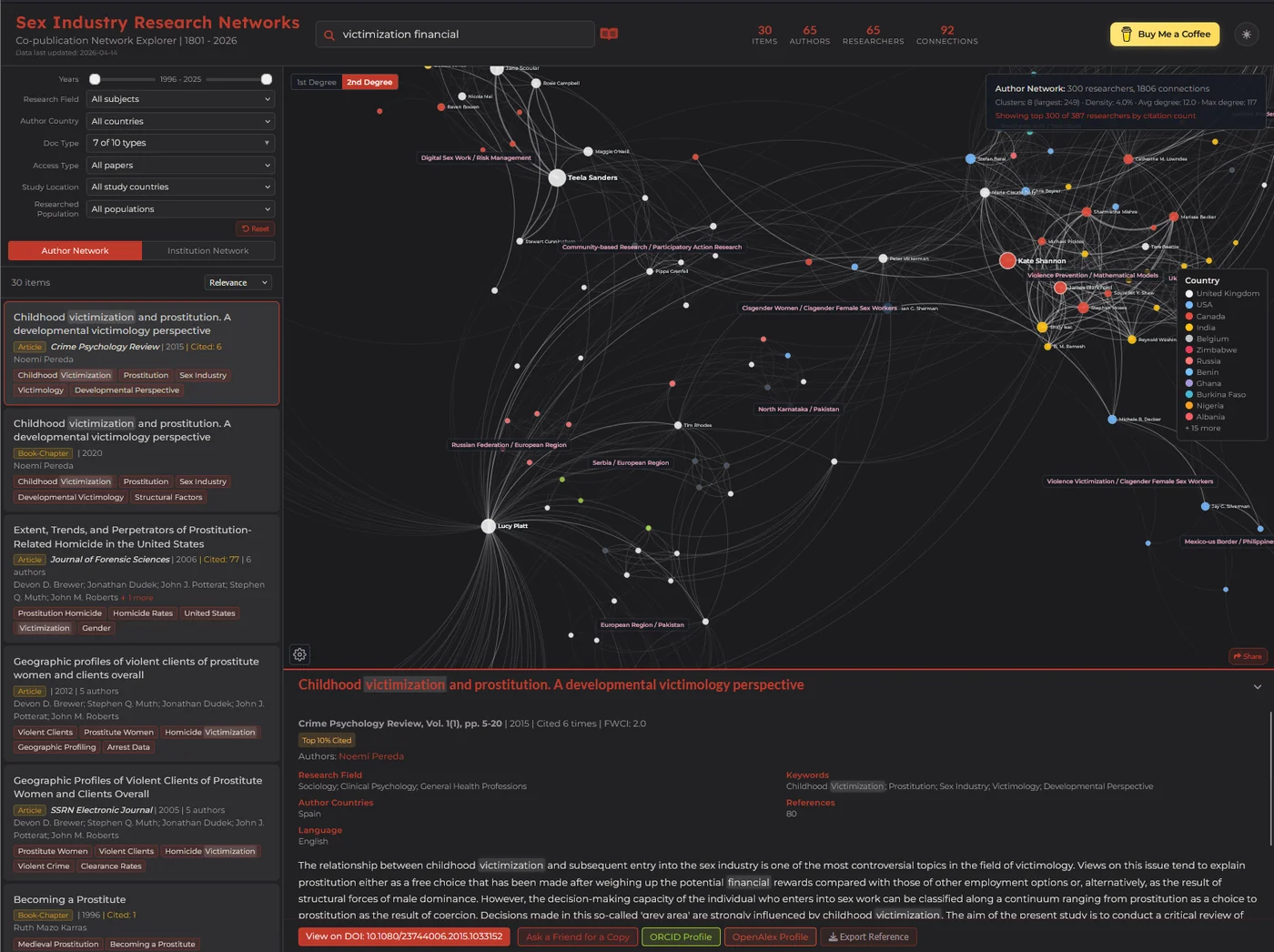
Sex Industry Research Network · Live
The problem. Most literature search tools make you guess the right keyword. Type "sex work" and you get one cluster of results; type "prostitution" and you get a different one. The papers don't know they're about the same thing — and the conversations across public health, criminology, sociology, gender studies, and law rarely cite each other.
The shape. A free, interactive map of global research on sex work, sex industries, and trafficking. 47,789 papers · 62,190 authors · 175,918 connections. Each cluster of papers is auto-labelled with what it's about, so you can see the shape of the field at a glance.
What you can do. Trace co-authorship paths to find adjacent literatures you'd never think to search. Filter by population, country, and document type — not just journal articles. Access open versions of papers where legally available.
Who it's for. Researchers writing literature reviews. NGOs trying to find evidence for funding bids. Policy folks who need to know what's been studied. Anyone tired of search-by-keyword.
Under the hood. AI and NLP techniques pull out where the research took place and the populations being studied — best effort from title, abstract, and metadata — which is what makes the filtering sharper than keyword search. More dimensions are straightforward to add: sample sizes, research methods, theories invoked, intervention types. If you'd work through literature more efficiently with custom filters, I can build that out for your needs in quick turnaround.
This is a pilot. I'm building networks across other domains too. Want one for your field, organisation, or policy team? pjb@sociologix.ca
The problem. Research on vulnerable populations — migrants, refugees, unhoused folks, people with disabilities, sex workers, people who use drugs — is scattered across public health, criminology, social work, disability studies, and policy journals that almost never cite each other. The papers about the same population live in disconnected literatures.
The shape. One navigable terrain that pulls those siloed conversations together. Co-authorship clusters auto-labelled with NLP; populations and study contexts (country, harm-reduction setting, etc.) extracted from titles and abstracts.
What you can do. Filter by population to see who's studying that group across all the disciplines at once. Trace adjacent literatures — find the paper in another field that turns out to be exactly what your literature review needs. Filter by document type so you're not stuck with only journal articles.
Who it's for. NGOs and policy teams who need cross-disciplinary evidence on a marginalised group. Researchers whose population sits awkwardly across two or three fields. Funders mapping coverage gaps.
Under the hood. AI and NLP pull out where the research took place and the population being studied — best effort from title, abstract, and metadata — which is what makes the cross-discipline filtering actually work. More dimensions are straightforward to add: sample sizes, research methods, theories invoked, intervention types. If you'd work through literature more efficiently with custom filters, I can build that out for your needs in quick turnaround.
Want a network like this for your population or policy area? pjb@sociologix.ca
The problem. The biggest meta-question in research is "what does the field look like?" — but answers usually come as one-discipline snapshots. Cross-discipline mapping at scale is rare, because the corpora don't talk to each other and the search tools weren't built for it.
The shape. A meta-network mapping the academic research enterprise across disciplines and decades, at a corpus scale orders of magnitude larger than any single field. Which disciplines cluster. Which authors bridge them. Where the structural gaps are.
What you can do. Find the bridging authors who connect your discipline to an adjacent one — the people whose work would help your committee, journal, or funding panel see the shape of the conversation. Filter by year or sub-field to see how the field has changed. Use it as a discovery tool when you're entering a new area.
Who it's for. Department heads and deans planning hires or programs. Funders mapping coverage. Journals deciding scope. Researchers entering a new field who want to read the room.
Under the hood. AI and NLP do the heavy lifting — clustering disciplines, identifying bridging authors, extracting locations and methodological signatures from abstracts and metadata. More dimensions are straightforward to add: sample sizes, research methods, theories invoked, populations studied. If you'd work through the literature more efficiently with custom filters, I can build that out for your discipline or institution in quick turnaround.
Custom version for your discipline or institution? pjb@sociologix.ca
What this is. Not a co-publication network — a department-level audit tool. Maps every full-time faculty member by what they research (Specialization mode) and what they teach (Teaching mode). Built originally so a colleague could prep for a tenure-track interview by reading the department's structure before walking in.
What it shows. Two interconnected views, sortable by rank, gender, course level, and degree origin. Live summary statistics update as you filter: gender split, average salary by rank, % Canadian-trained vs. American vs. international. Specialization silos. Teaching coverage gaps.
Who it's built for. Hiring committees doing gap analysis before the next round. Department leadership auditing their own coverage. Students choosing potential supervisors by topic fit. Job applicants reading the room before the interview.
About the data. The pilot uses real data from a Canadian criminology department. Faculty names anonymized as Faculty 1, 2, 3...; specific universities replaced with training-origin labels; salaries rounded to the nearest 10k; course codes replaced with sequential Course #N. Aggregate patterns are preserved exactly — the audit value is in the patterns, not the identifiers.
Want one for your department? The infrastructure is portable; the visualization, filters, and stats are already built. The work is mapping your data to the model — which fields to include, which audit questions you actually want answered. Reach out: pjb@sociologix.ca
Design. Three dimensions are not enough. How do we represent twelve substantively distinct classifications of behaviour without flattening their relations to each other? How do we make a four-dimensional model navigable?
Resolution. Layered Multiple Correspondence Analysis on 1,133 Canadian sex buyers, rendered as a four-dimensional interactive model. Past, present, and future actions plotted simultaneously, each dimension toggleable.
Context. The 2017 model (Margins of Freedom) was, to my knowledge, the first explorable 3D Multiple Correspondence Analysis in published sociology — MCAs in the literature have almost always been static 2D scatter plots. This 2019 model goes a step further and is, to my knowledge, the first 4D MCA — built on three.js, with the fourth dimension fade-toggled between past, present, and future action sets.
A fully integrated three.js framework — input your own MCA data, get an explorable 3D/4D model — is in development. Open-source on GitHub when ready.
2017 · 3D Model
Design. Health behaviours are classed — but which class produces which dispositions, and how do those dispositions relate? Can we render Bourdieu's field theory as a three-dimensional spatial model?
Resolution. Interactive 3D model of class-based health dispositions and practices, derived from the Margins of Freedom paper. Dimensions: economic capital, cultural capital, and practice intensity.
Context. To my knowledge, this is the first explorable 3D MCA in published sociology. The standard practice has been static 2D scatter plots — projections of a multi-dimensional analysis onto a single page. Built in three.js so the field of power is fully rotatable and selectable rather than flattened.
A fully integrated three.js framework — input your own MCA data, get an explorable 3D/4D model — is in development. Open-source on GitHub when ready.
2017 · Geospatial Network
Design. Where do people who pay for sexual services in Canada actually travel? Are markets local, regional, or national? What do the travel patterns reveal about how the industry operates spatially?
Resolution. Geographic network visualization built from 1,133 survey responses. Node = city. Edge = travel from home city to purchase city. Edge weight = volume.
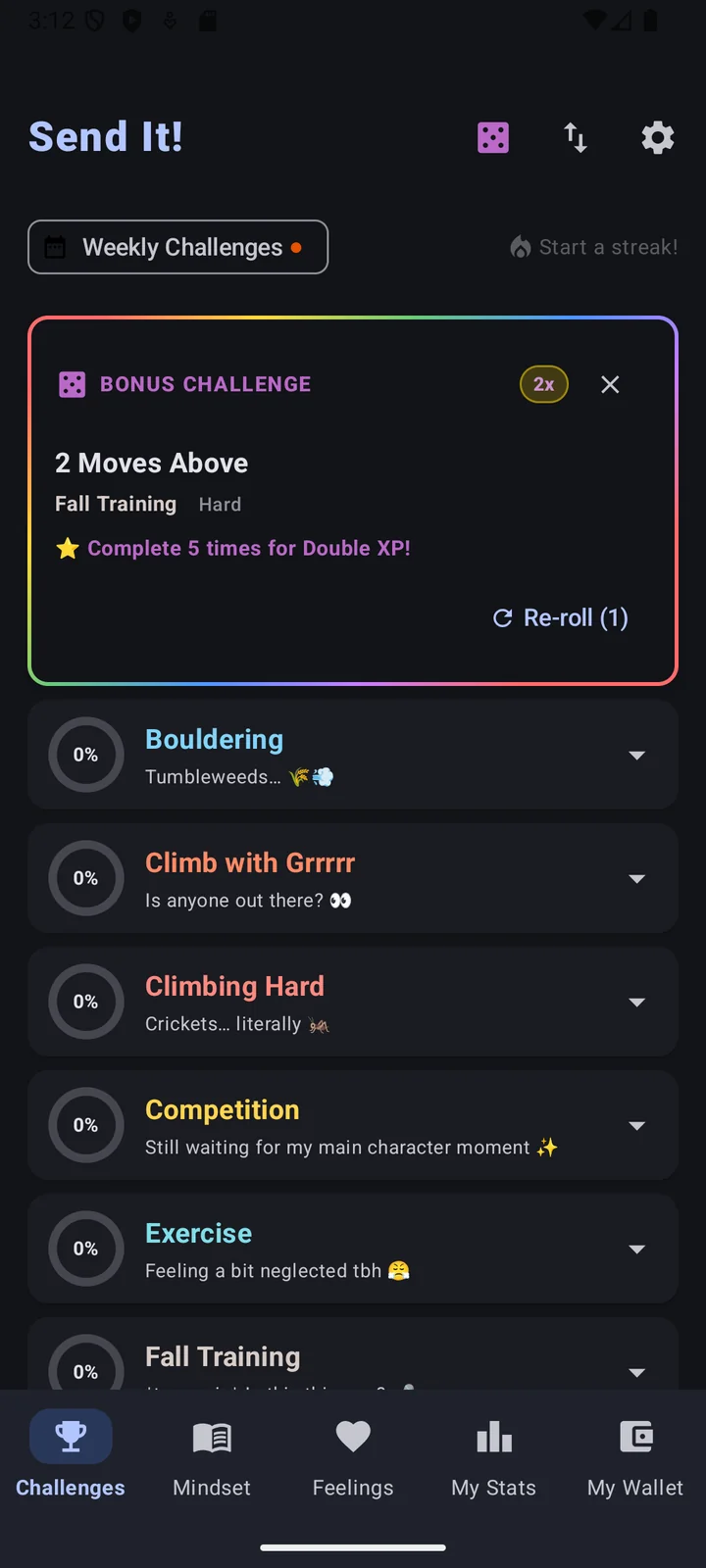
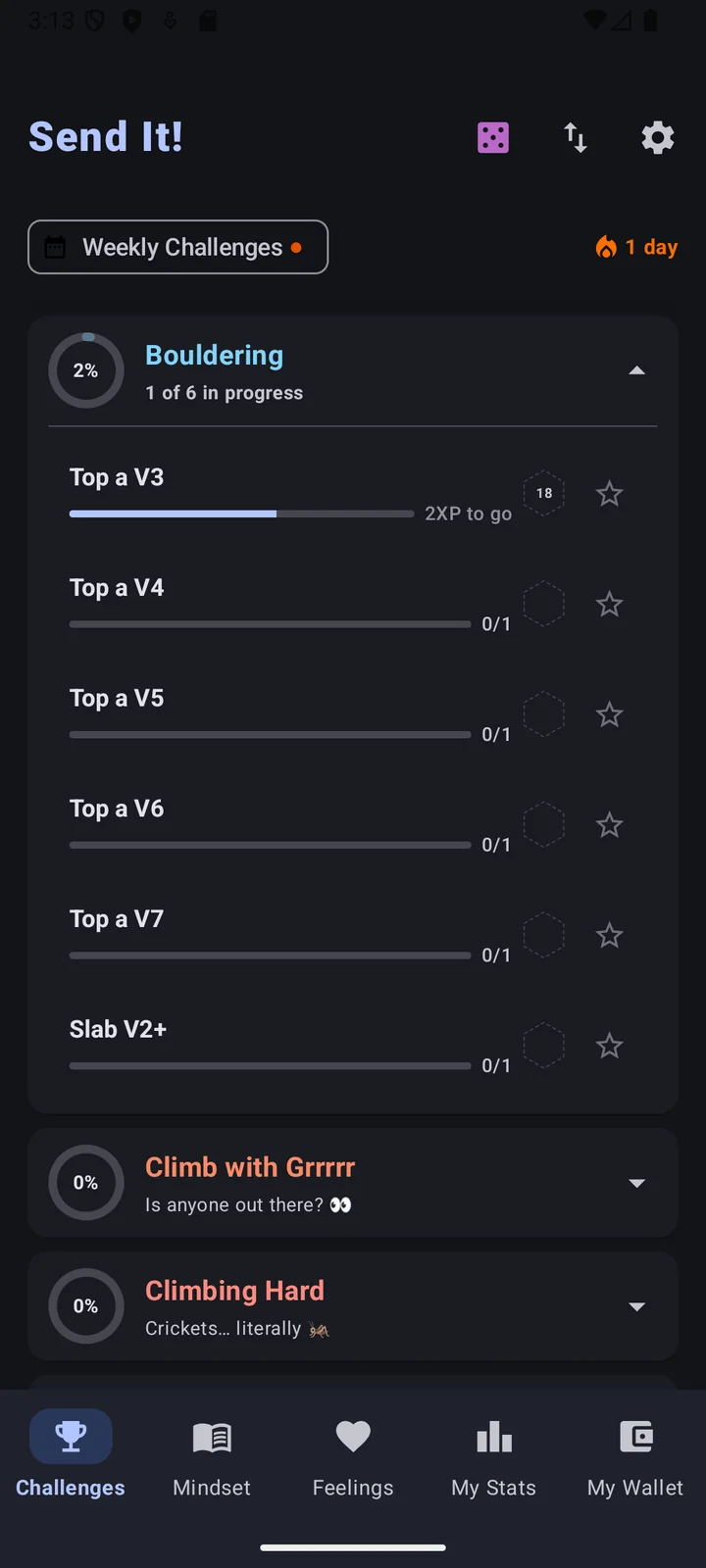
Send It! · 2025 · Personal build · Android · Jetpack Compose · in daily use
Design. Built for my daughter — a competitive young climber who wanted a way to track skill development that felt like progression, not a spreadsheet. The frame is adventure-game DNA: every skill (bouldering, sport, technique, endurance) is a quest line; every challenge is a step on it; mastery is a path you walk, not a checkbox you tick. The name nods to the climbing term itself — to send a route is to complete it cleanly, top to bottom.
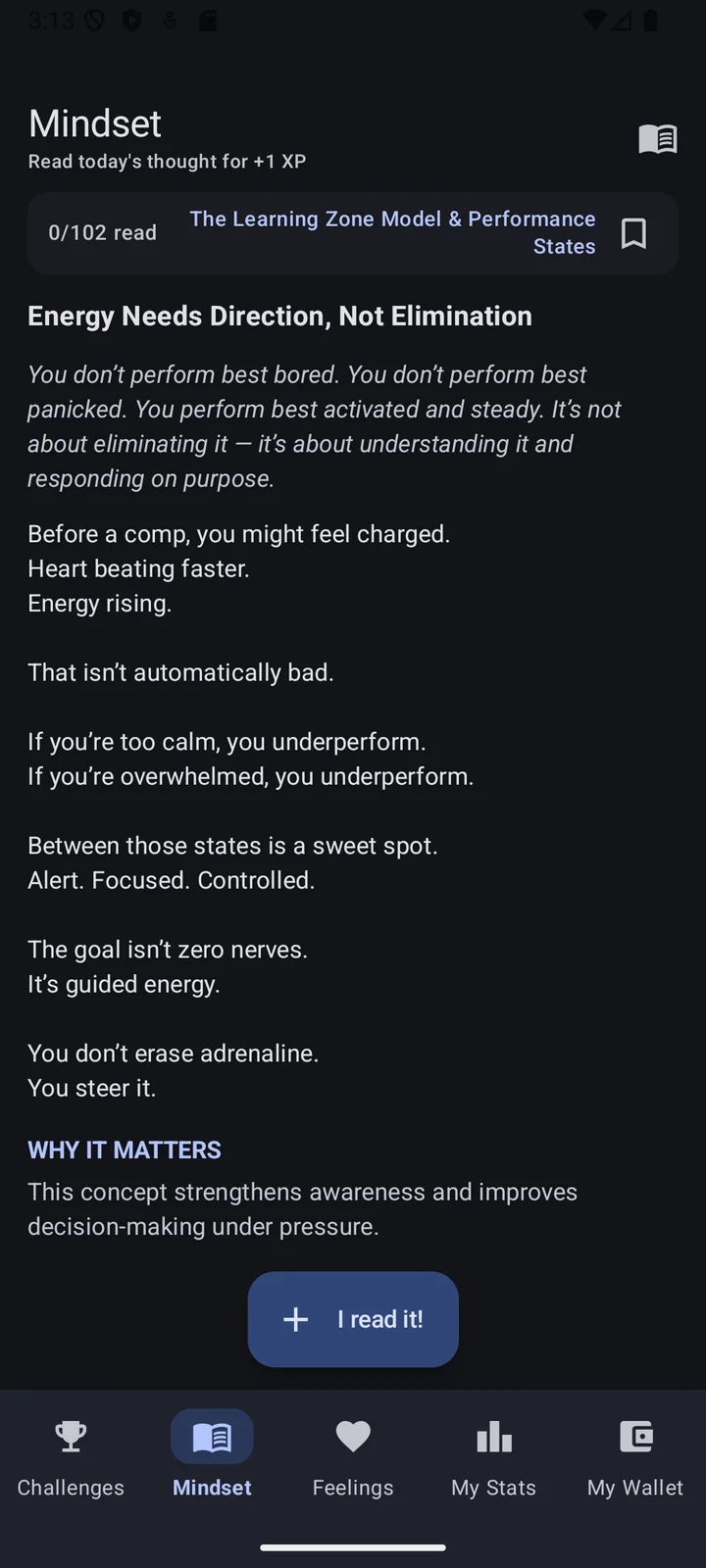
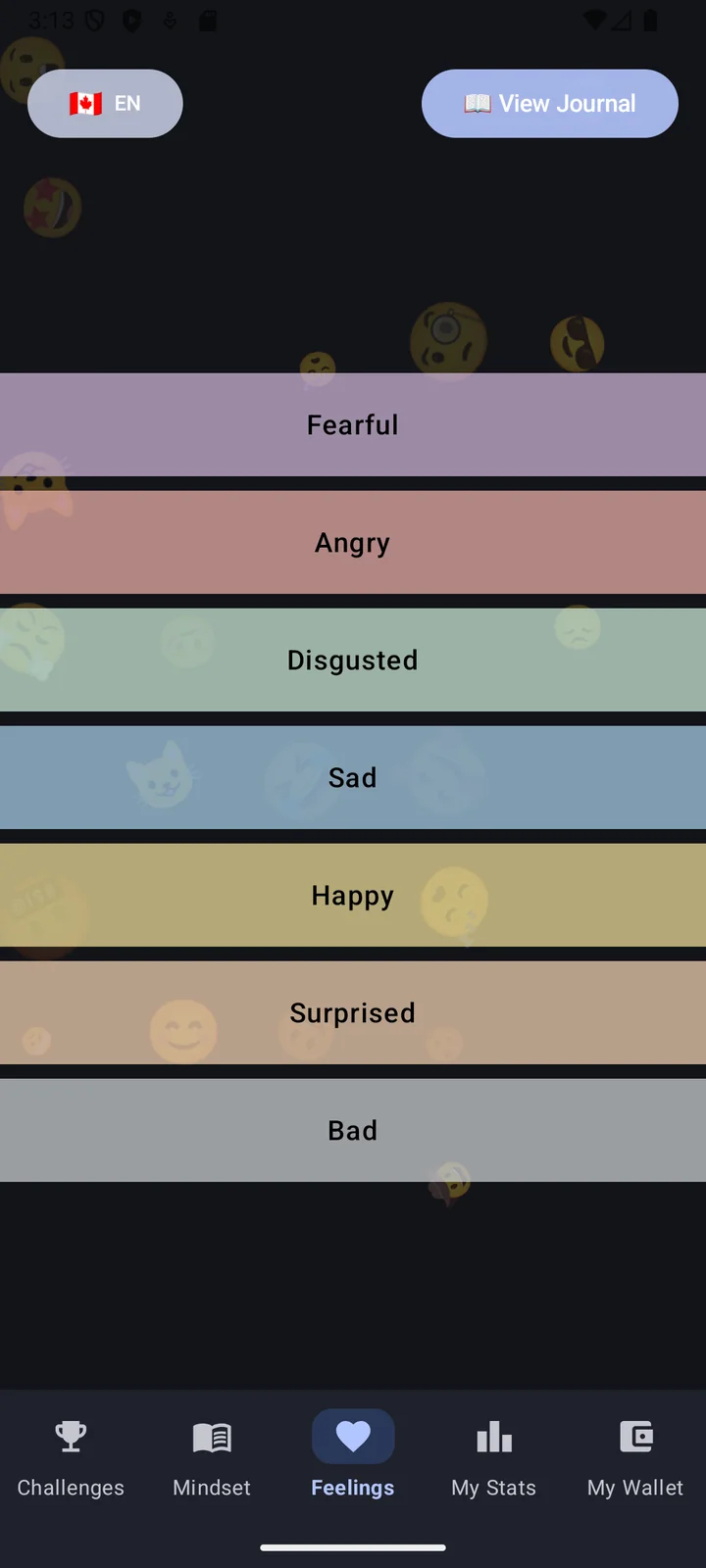
Resolution. Six-tier mastery system — Crusher → Sender → Legend → Immortal → Mythic — each tier triggered by completion thresholds (1×, 3×, 6×, 10×, 15×). XP system with two modes (per-completion and crossing-the-threshold lump sums). 102 daily mindset snippets on the mental side of climbing, with reading streaks. A feelings tracker my daughter built herself for a school coding challenge, integrated as her own contribution to the app. Bonus-challenge dice pool. Prize redemption shop. Hibernation state for fully-mastered challenges so they're celebrated rather than endlessly repeated.
Stack. Kotlin · Jetpack Compose · Room (v12, with migrations) · Hilt · MVVM clean architecture · DataStore for preferences. JSON v3 backup/restore. Five Room entities, deterministic message lists for stable recomposition.
The reason this is here: most consumer-app engagements aren't about a polished store launch — they're about scoping a niche use case nobody else is serving and getting to a v1 that gets used daily. That's the part most projects die on. I do it on weekends because I enjoy it.
2026 · Android · Jetpack Compose · in development, headed for release
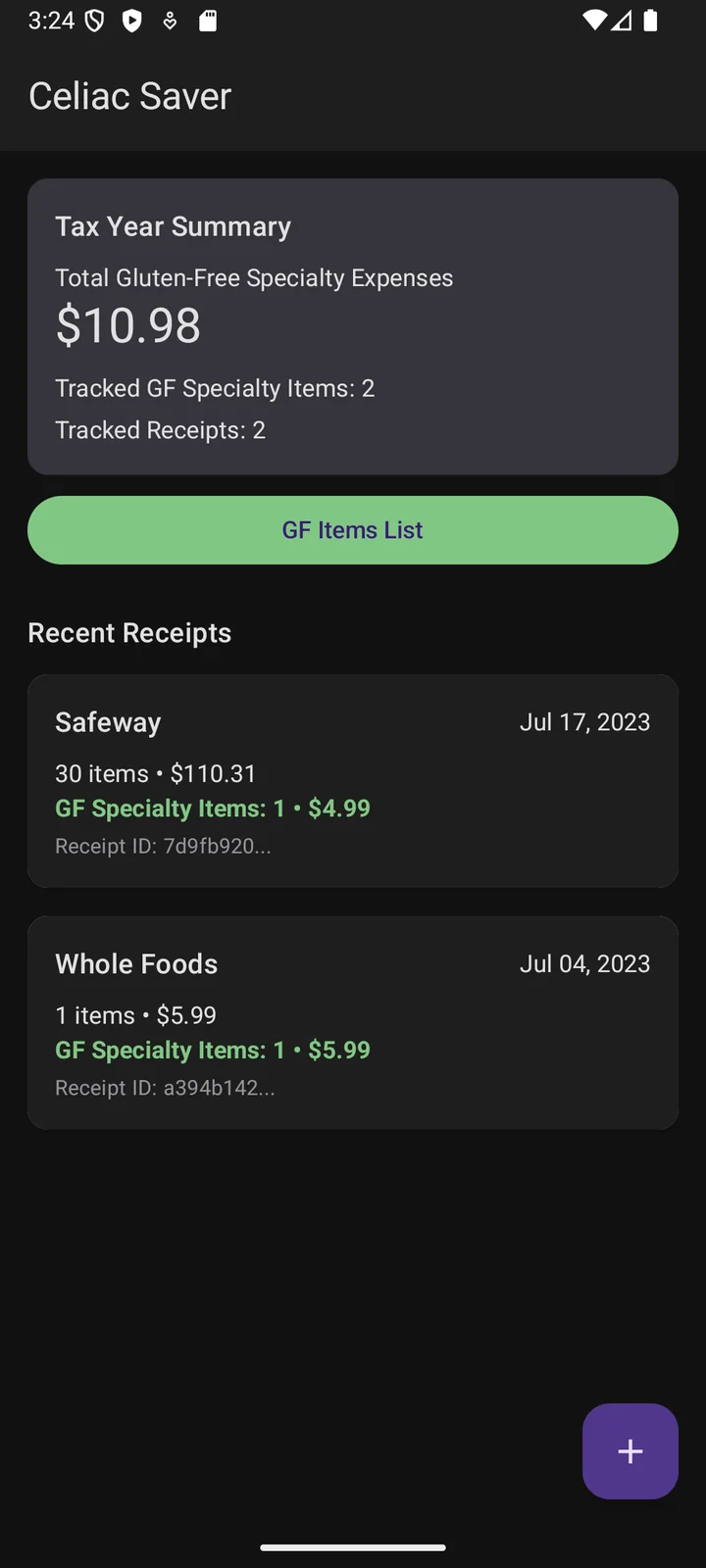
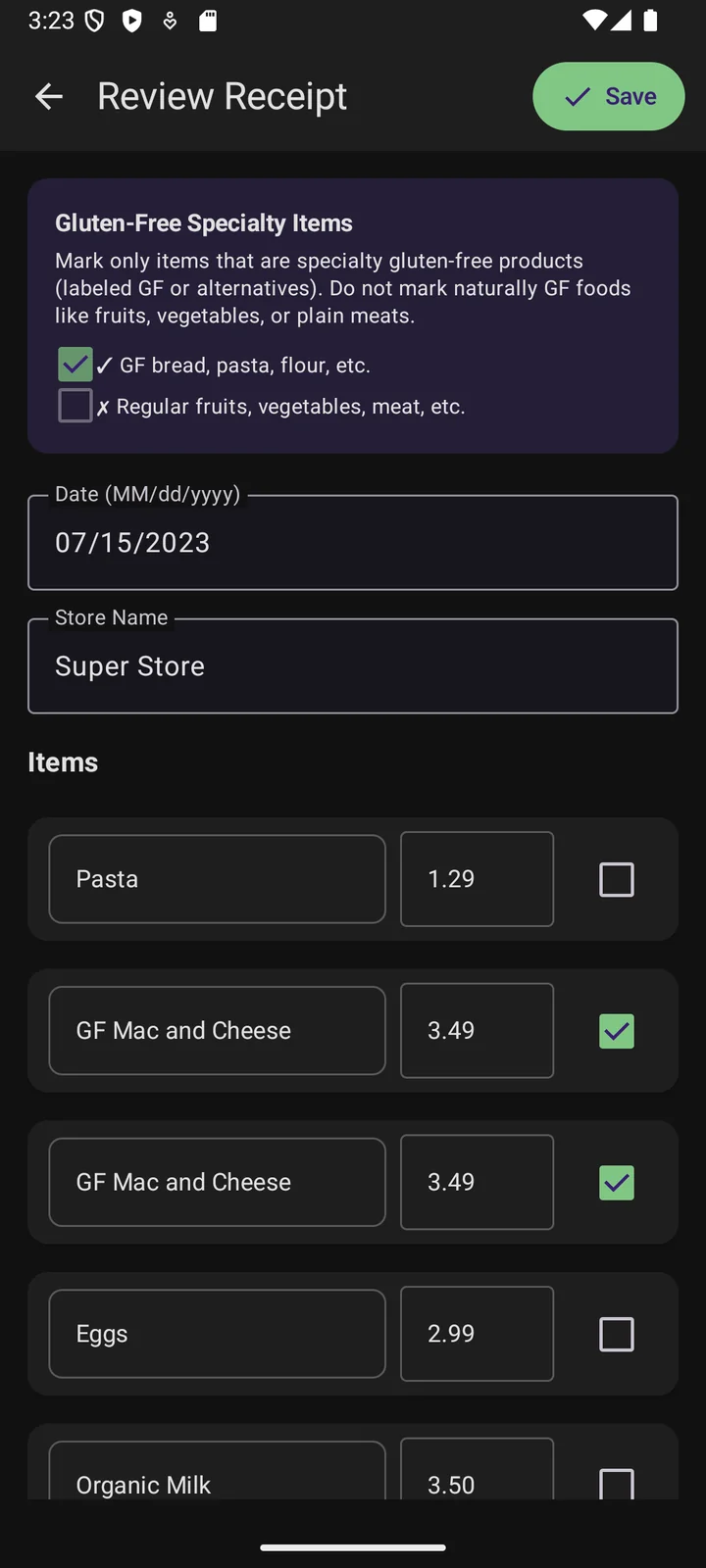
Design. Canadian tax law lets people with celiac disease claim the incremental cost of gluten-free items as a medical expense at tax time — the difference between the GF version and the regular equivalent. Almost nobody claims it. The math is real money (a celiac household can recover hundreds to thousands of dollars per year), but tracking it manually is exhausting: every receipt, every item, every comparable non-GF price, summarized in the format the CRA expects. My kids have celiac, so we take the hit at the till every single grocery trip. The bookkeeping burden is what stops most families from getting any of it back.
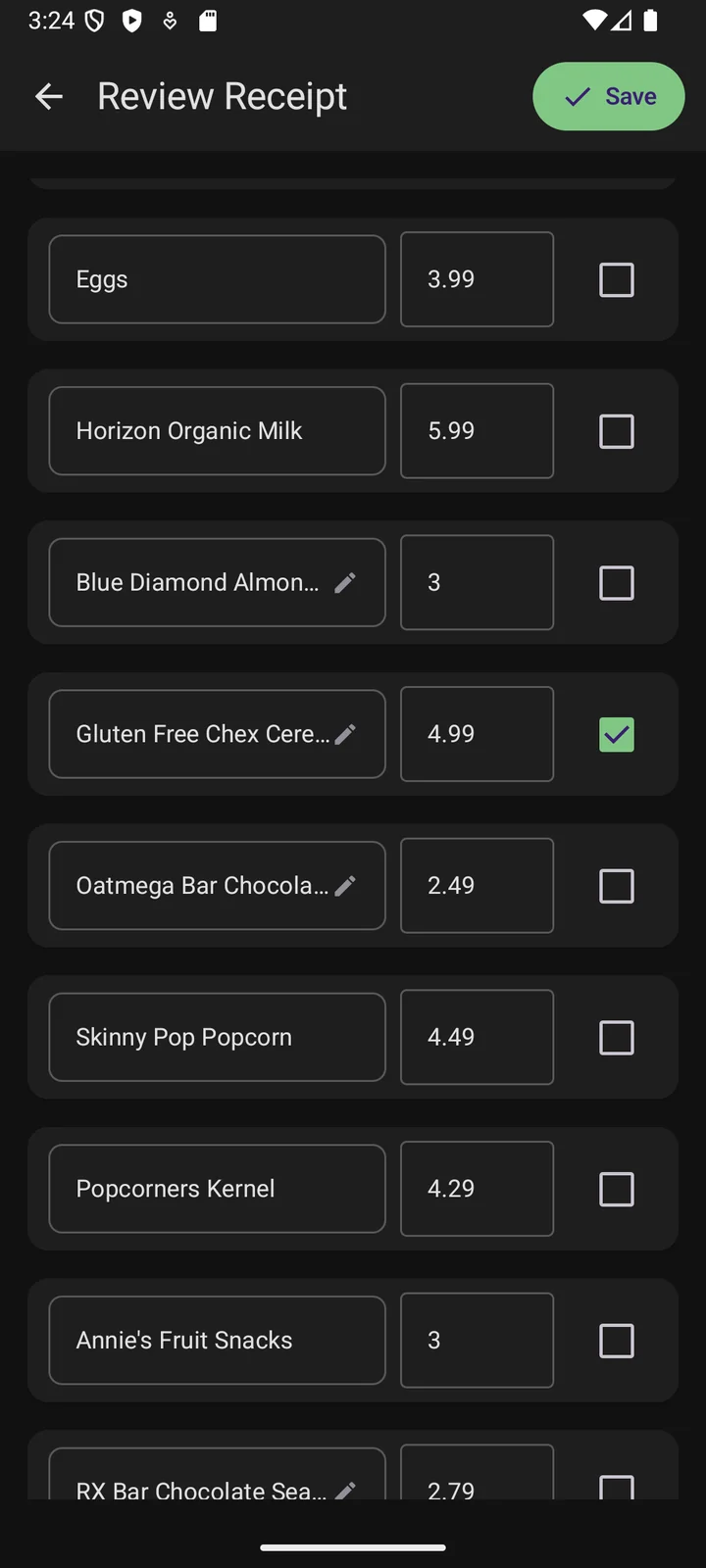
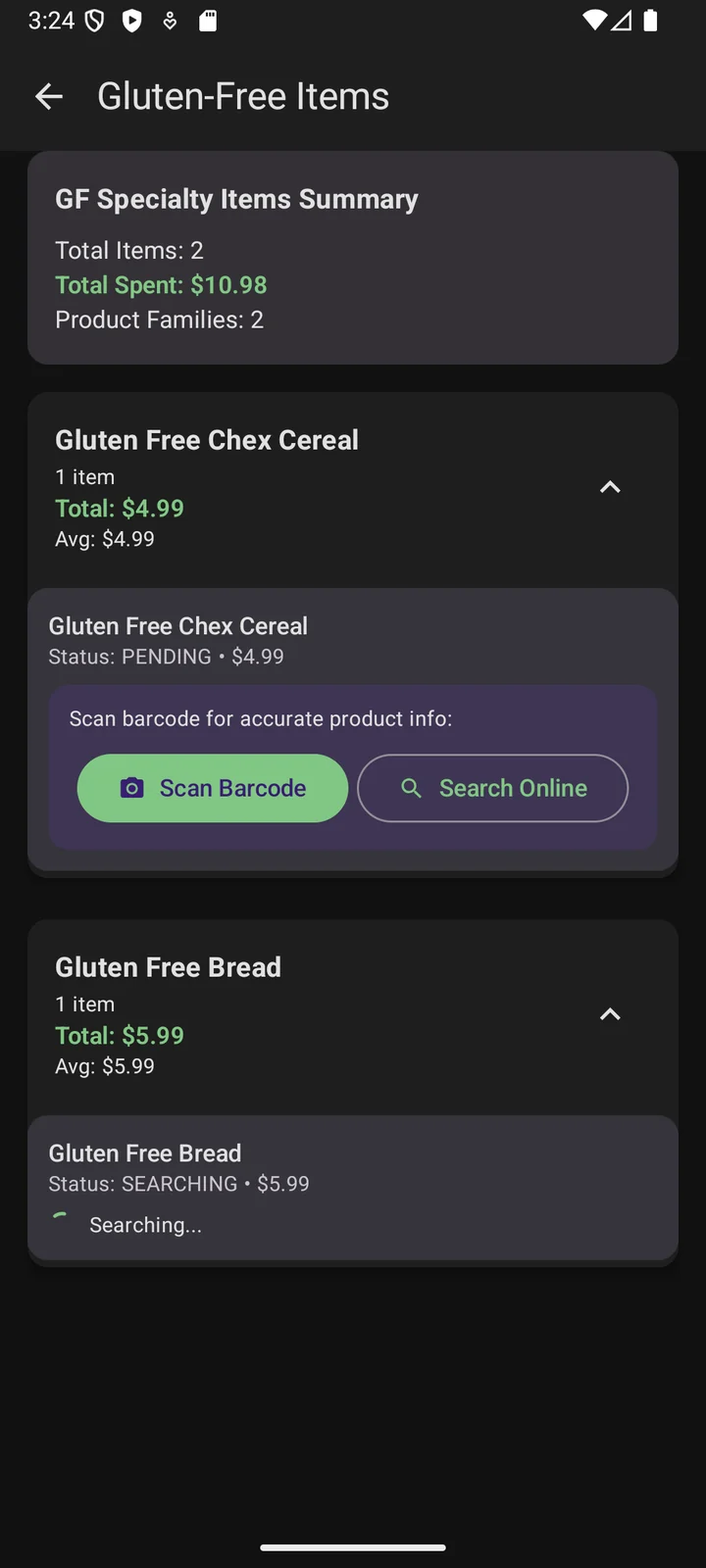
Resolution. An AI-processed receipt tracker. Snap a photo after every grocery trip, an LLM parses items, flags GF products, looks up comparable non-GF prices, and accumulates the year's incremental-cost ledger. End-of-year summary in CRA-ready form. Reduces a year of manual tracking to a phone scan per receipt. Currently refining for public release.
Applied AI in service of financial relief for people already shouldering a higher cost of living. If you have a niche compliance problem where AI can do the boring repetitive part and a real human gets the money back at the end — that's the kind of brief I'll move on fastest.
Design. A joint project with François Lachapelle. Where are Canadian university faculty trained? Has that changed across forty years? Which institutions reproduce the field, and which barely register? A queryable lens on a closed labour market — built together over months, not handed off to anyone.
Resolution. 4,934 full-time U15 social-science faculty, every PhD-granting institution they came from — hand-collected together from microfiche archives, hard-copy academic calendars, and digital sources. Plotted as a country-share line chart that drills into a top-20 institutions bar chart on click. Filter by university class, department, and rank; compare incoming vs. outgoing cohorts.
Context. The empirical backbone of the 2018 Canadian Review of Sociology paper Patrick and François published together (Lachapelle & Burnett). The dataset became the seed corpus for Subfield — same shape, generalised to all disciplines and the rest of Canadian academia, still co-built with Lachapelle. Couldn't have done either project alone.
2010–2014 · Scrollytelling · NeuroDevNet
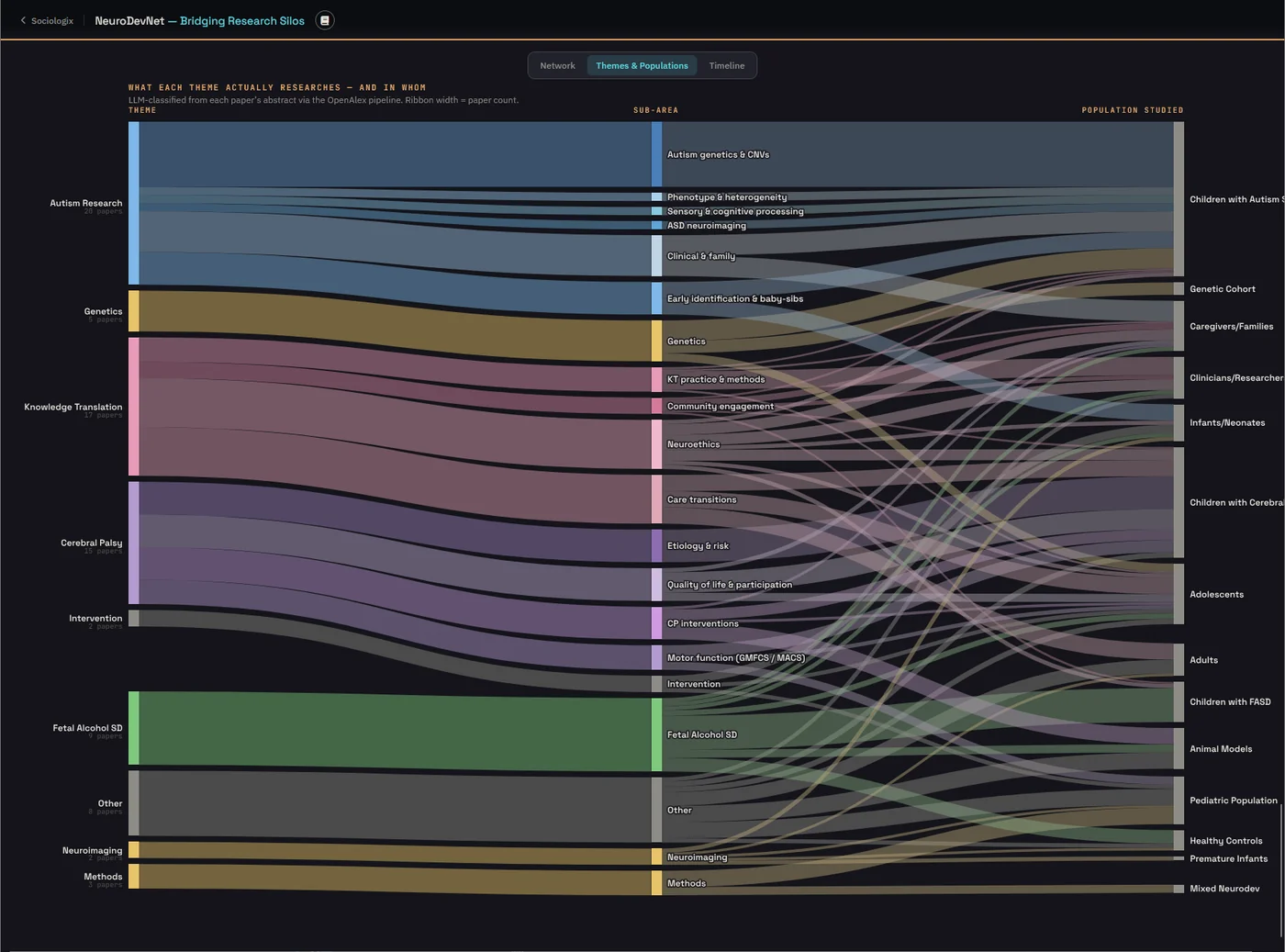
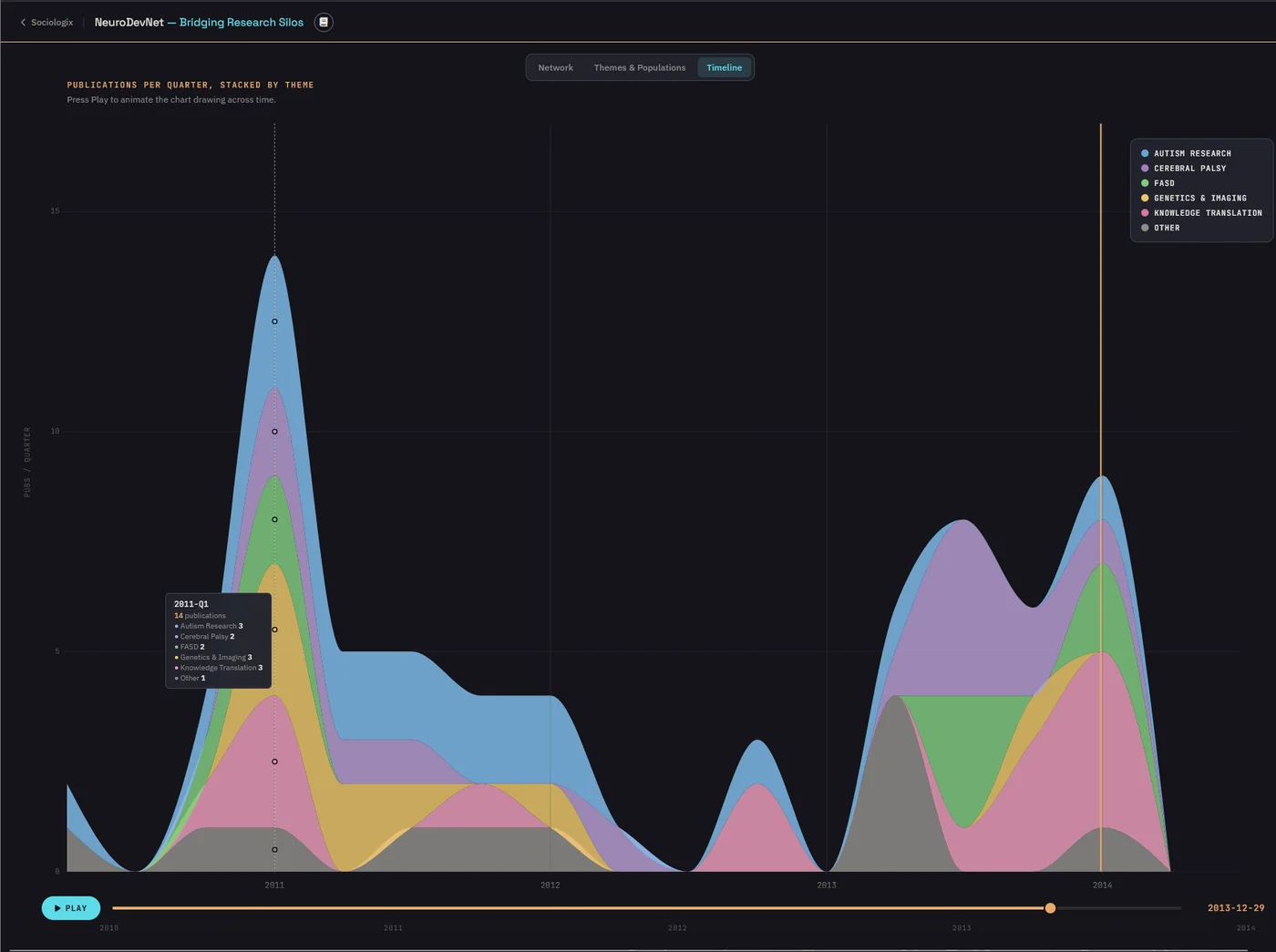
Design. How do you make the impact of a federally-funded research network feel like a living, growing thing rather than a 60-page PDF nobody reads? The technique is called scrollytelling — the same scroll-driven narrative format the New York Times R&D group, The Pudding, FT Visual Stories, and Bloomberg Graphics use to turn dense datasets into stories that hold attention from first scroll to last edge.
Resolution. 316 researchers, 2,903 collaborations, 81 papers, four years of network growth. Each scrollable section pins an interactive scene to the viewport, rebuilds it as you advance, and lets the data unfold beat-by-beat: network growth, then thematic Sankey flows, then annual stacks of co-authorship — each scene answering a different reviewer question.
Themes → subthemes Sankey sceneAnnual co-authorship stack scene
Outcome. NeuroDevNet's renewal application included an early version of an evolving network visualization. They got the second round of federal funding.
If you've published research that deserves better than a 60-page PDF nobody opens — a longitudinal study, a clinical trial, a network analysis, a programme evaluation — let's turn it into something funders, journalists, and the public actually want to scroll through.
Le Mystère du Manoir Beaumont · 2025 · Interactive study tool · live
Design. My daughter had a French exam coming up and was genuinely worried. She is an auditory learner who loves mystery novels — which meant a grammar worksheet was exactly the wrong tool. So I built her the right one: a murder mystery where the inspector solves the crime by catching the killer's grammar mistakes. The story tests you as you go — choose the right grammatical response, and the case advances. Choose wrong, and Inspectrice Rousseau loses the thread.
Resolution. Nine chapters of original French narrative. Interactive decision points that test verb conjugation, COD/COI agreement, past participles, and time markers — woven into the investigation, not bolted on as exercises. Four language levels selectable at any time: full French, French with English scaffolding, English with French scaffolding, or full English. Every chapter narrated in audio so an auditory learner could literally listen her way to exam day.
Stack. Story, characters, grammar scaffolding, and the page itself co-written with Claude via Claude Code — I directed, Claude drafted, I revised. Audio narration generated with Gemini's voice model. Static HTML/CSS/JS, no backend. Scoped, written, voiced, and shipped in a few hours.
Outcome. She aced it.
The transparent version of the pitch: this is the speed AI tooling now affords. Real problem in the morning, working v1 by the afternoon, in production for the person who needed it. Same playbook works for client problems — internal tools, niche compliance, prototypes, study aids — anywhere a well-directed AI-assisted v1 beats waiting six months for a perfect spec.